News
Why Structural Steel and Precast Concrete Perform Better Together — and Why Integrated Delivery Makes the Difference
Executive Summary
Commercial and industrial construction across Greater Geelong depends on structural steel and precast concrete working as an integrated system — yet most projects procure them separately, creating the coordination gaps that blow out timelines and expose developers to compounding risk.
This article examines the critical role structural steel plays in precast concrete construction, why the two materials are engineered to complement each other, and how Chalmers Constructions' vertically integrated delivery model eliminates the handover failures that fragmented procurement cannot avoid.
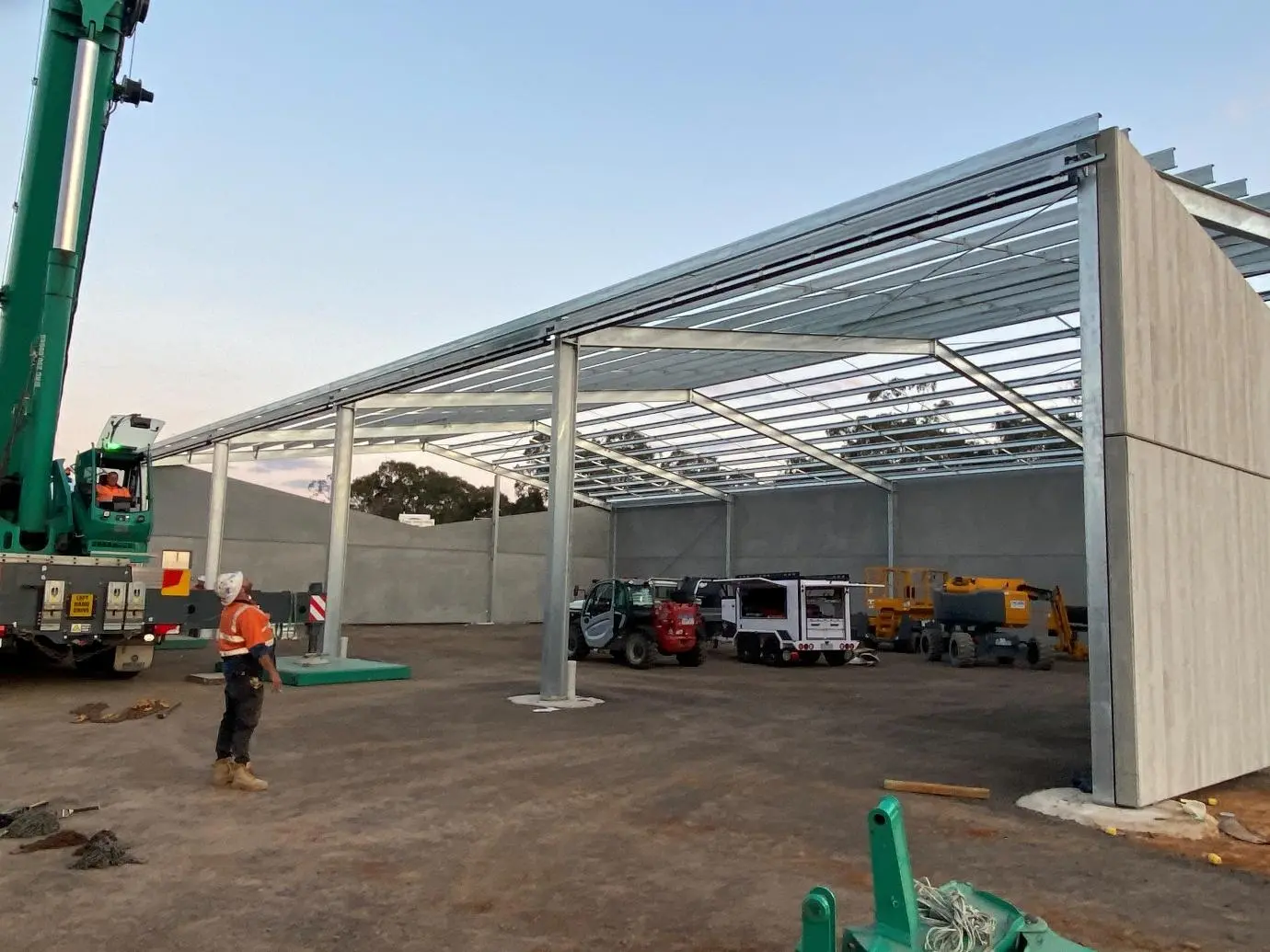
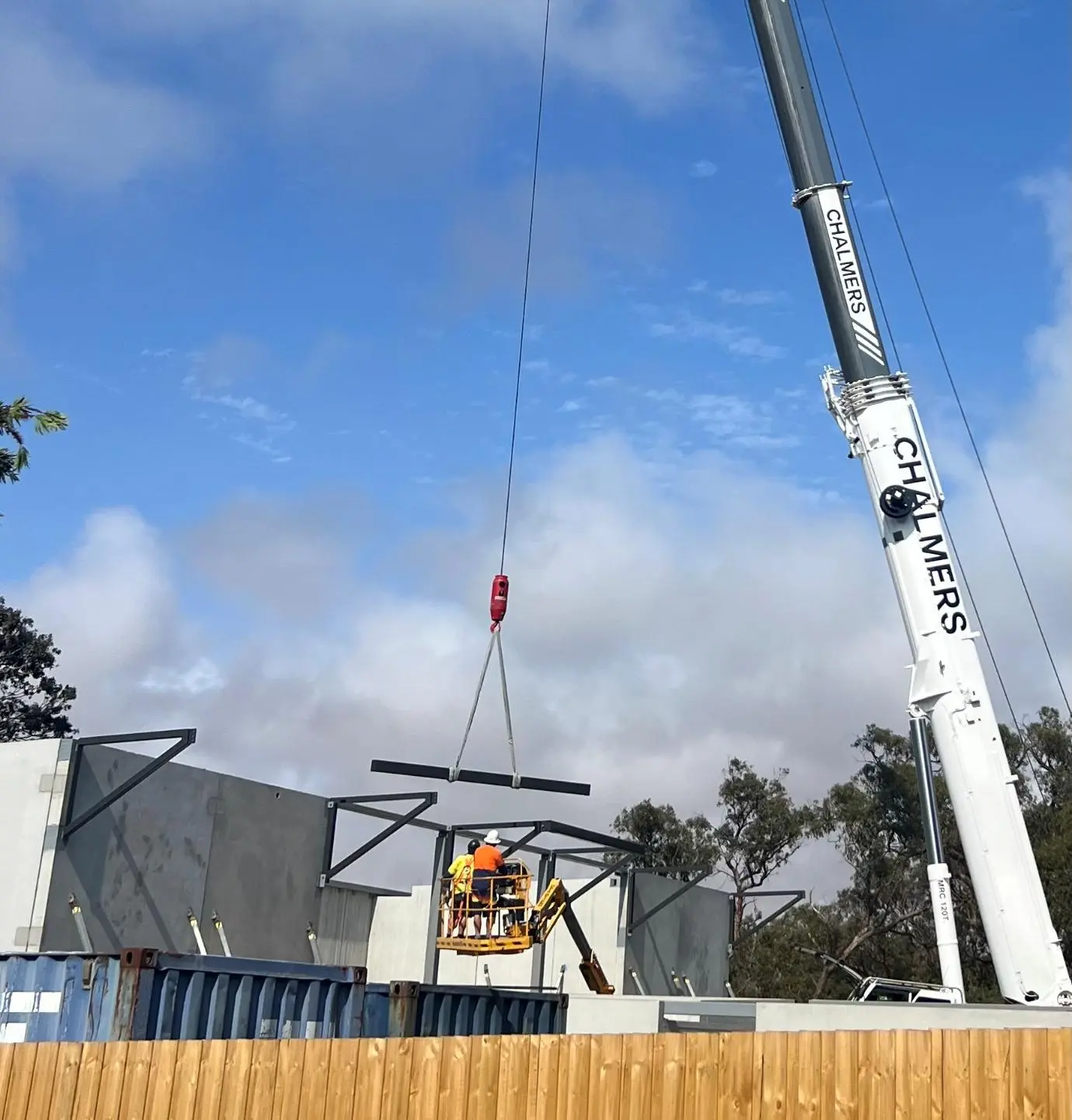
From boilermaker fabrication in our Torquay facility through to structural panel installation with our 120T Liebherr LTM 1120-4.1 crane, we control the complete value chain — giving architects, developers, structural engineers, and commercial builders a single accountable partner from design through to final installation.
For any project where structural precision, schedule certainty, or architectural finish quality is non-negotiable, this article demonstrates why integrated capability consistently outperforms separate-contractor procurement.
Technical Terms Used in This Article
1. The Structural Role of Steel in Precast Concrete Construction
Structural steel and precast concrete are not competing systems. They are engineered to work together, and the quality of that collaboration directly determines whether a building is delivered to specification, on schedule, and without costly remediation.
In precast concrete construction, structural steel performs three distinct functions: it forms the connection mechanism between panels and the primary building structure, it provides the reinforcement within panels that enables the spans and load ratings structural engineers specify, and — when a project includes architectural facades or complex geometries — it forms the ancillary framing that precast panels attach to and load through.
How steel connections determine panel performance
Every precast concrete panel leaves a manufacturing facility carrying embedded steel elements. Plates, angles, and threaded inserts are cast directly into the panel during the pour, positioned precisely to match the engineered connection drawings. When the panel arrives at site, these embed plates become the interface points where structural steel columns, beams, and cleats are welded or bolted to transfer loads into the building frame.
The precision of those connections is not a site variable. It is a manufacturing variable, determined by how accurately the steel embeds were positioned in the formwork before the concrete was poured. A 5mm positional error in an embed plate — invisible during panel manufacture — can create a misalignment that requires site remediation, delays installation, and introduces structural uncertainty that engineers must resolve in the field.
This is why the integration between steel fabrication and precast manufacture matters. When the same team fabricates both the embedded steel elements and manages the panel production, positional tolerances are verified before concrete is poured, not after panels arrive on site.
Reinforcement steel as the structural backbone
Within each precast panel, the reinforcement cage is the structural element that determines load capacity, span capability, and long-term performance. Chalmers employs qualified boilermakers whose precision fabrication skills — normally associated with complex structural steel assemblies — are applied with equal rigour to the reinforcement cages that go into our panels.
This is not incidental. The same welding standards, dimensional discipline, and quality control that our boilermakers bring to structural steel fabrication for warehouse frames are applied to the reo cages that form the skeleton of every panel we manufacture. The result is reinforcement that is correctly positioned, properly tied, and dimensionally accurate before a single cubic metre of concrete is placed.
Structural steel frames as the system these panels connect to
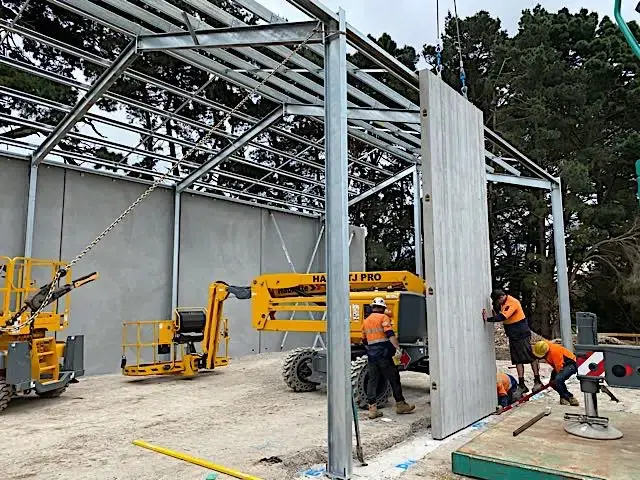
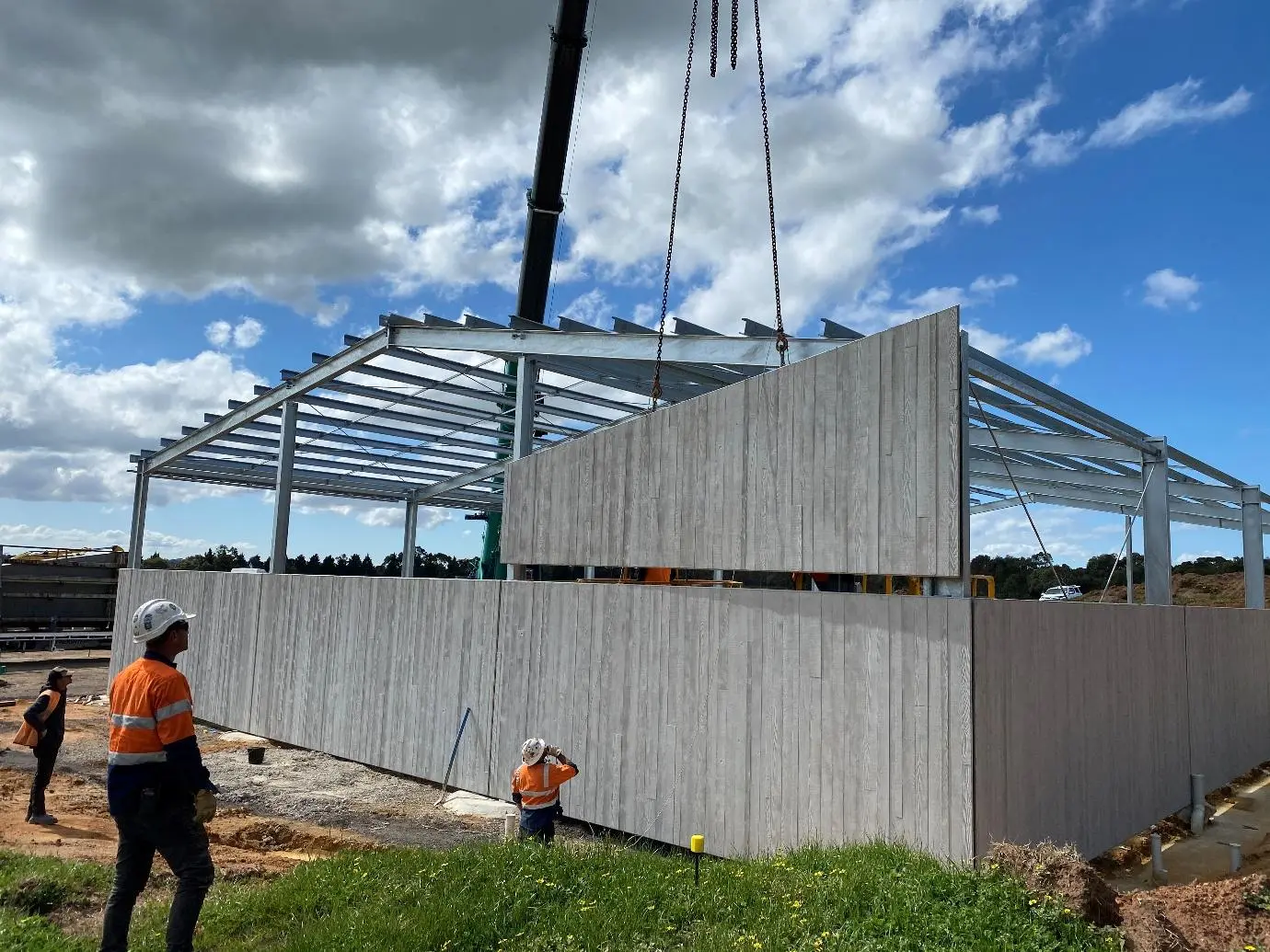
For commercial warehouses, industrial facilities, and multi-storey commercial construction across the Greater Geelong region, the structural steel frame is typically the primary load-bearing system. Precast concrete panels — whether used as structural walls, architectural facades, or combined load-bearing and aesthetic elements — must connect to that steel frame with the precision the structural engineer has specified.
When the contractor who fabricates the structural steel frame is also the contractor who manufactures and installs the precast panels, the interface coordination that normally requires extensive engineering correspondence, site meetings, and drawing revisions is resolved internally. Dimension changes, connection modifications, and sequencing adjustments are managed between our own fabrication and manufacturing teams — not across separate company boundaries.
2. Why Conventional Procurement Fails at the Steel-Concrete Interface
The standard procurement model for commercial construction separates structural steel and precast concrete supply into distinct subcontractor packages. A steel fabricator supplies and erects the frame. A precast supplier manufactures and delivers the panels. A crane hire company manages the lifts. A separate concreter handles any on-site pours. Each trade operates under its own contract, its own schedule, and its own variation and delay provisions.
This fragmentation creates a specific and predictable failure pattern at the steel-to-precast interface.
The coordination gap that compounds risk
Structural steel frames are fabricated from detailed engineering drawings. Precast panels are manufactured from separate detailed drawings. The connection between them — the embed plates, cleats, and weld positions — must align precisely in three dimensions when the panel arrives at site.
Under fragmented procurement, the steel fabricator and the precast manufacturer are not in the same organisation. They work from drawings produced at different times, coordinated through a project manager who cannot be in two places simultaneously. Drawing revisions in one package require coordinated updates in the other. When revisions are missed or communicated late, the discrepancy appears at the lift — after the panel has been manufactured, transported 50 kilometres, and is hanging from a crane on a site where every minute of delay costs money.
Schedule dependencies that cannot be managed externally
Precast panel manufacturing requires lead times of four to twelve weeks depending on panel complexity and production loading. Structural steel fabrication operates on similar lead times. When both trades share the same installation window — as they do on virtually every commercial construction project — delays in one trade directly compress the other's installation time.
A steel erection delay of two weeks does not simply push the program by two weeks. It compresses the precast installation window, forces the crane to work in a sequence that was not planned, potentially leaves finished panels sitting in the manufacturer's yard accumulating storage costs, and creates a cascade of downstream delays to cladding, services, and fit-out that developers must absorb.
An integrated contractor who owns the crane, manufactures the panels, and fabricates the steel can manage these dependencies as internal scheduling decisions. A project manager coordinating three separate subcontractors cannot.
Quality accountability gaps
Under fragmented procurement, the interface between structural steel and precast concrete is a contractual gap as much as a technical one. When a panel does not align with the steel frame as detailed, each subcontractor's natural response is to identify why the problem originated in the other party's scope. Resolving that dispute takes time, legal correspondence, and engineering resources that the project simply cannot afford mid-installation.
Integrated delivery eliminates this gap entirely. When the same organisation fabricated the steel and manufactured the panel, there is no contractual boundary to argue across. The problem is found and resolved internally — typically before it becomes a site problem at all.
3. The Chalmers Integrated Structural Steel and Precast Concrete Capability
Chalmers Constructions operates from a 3,000m² manufacturing facility in Torquay with dual street access, two precast casting beds, a 12.5-tonne overhead crane for in-facility panel handling, and in-house boilermaker fabrication capability. We own and operate a 120T Liebherr LTM 1120-4.1 all-terrain mobile crane with a 66-metre main boom for installation on Greater Geelong projects.
This combination of capabilities is not accidental. It reflects a deliberate business model built around the principle that controlling the complete value chain — from steel fabrication through concrete manufacturing to crane installation — is the only reliable way to deliver complex construction projects to the specification, finish quality, and schedule that commercial clients require.
In-house boilermaker fabrication: precision that carries through to the pour
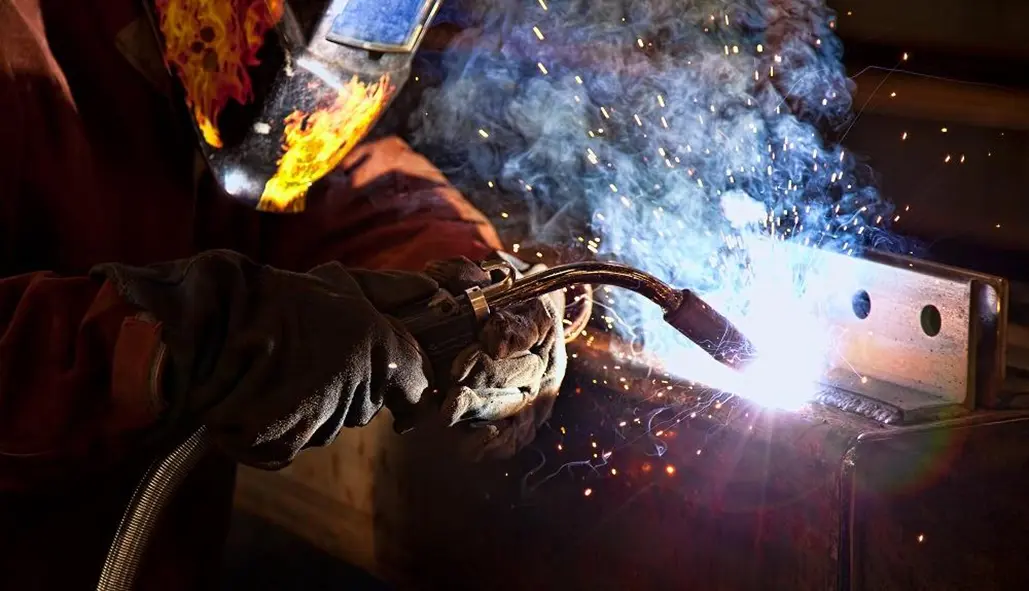
Our boilermakers fabricate structural steel to the same precision standards that define our precast manufacturing. For warehouse projects, this means steel portal frames, purlins, girts, and connection cleats fabricated in-house and coordinated directly with our precast production schedule. For architecturally complex projects, it means custom embed plates, feature steel elements, and connection hardware fabricated with the dimensional accuracy that our panel production demands.
The critical advantage is not simply that we do both. It is that the people managing the steel fabrication and the people managing the panel production communicate directly, share the same drawings, and resolve interface issues before concrete is poured rather than after panels are on site.
The magnetic formwork system and precision manufacturing environment
Our magnetic formwork system enables dimensional precision that is categorically superior to standard casting methods. Formwork elements are positioned and locked magnetically, eliminating the deflection and movement that creates dimensional variation in mechanically clamped systems. Steel embed plates and connection hardware are positioned within the form and verified against the structural drawings before the pour proceeds.
The result is panels with connection points in the correct location, surface finishes that are blemish-free, and dimensional tolerances that structural engineers can rely on. This is not a claim — it is an engineering outcome of manufacturing in a controlled factory environment rather than on an exposed construction site.
20+ warehouses in Torquay Industrial Estate: the proof in the portfolio
Over the past decade, Chalmers Constructions has delivered more than 20 warehouse and industrial facilities in the Torquay Industrial Estate, working in extended collaboration with key regional developers. These projects span conventional clear-span warehouse construction through to architecturally specified commercial facilities requiring custom panel finishes, over-height structural panels, and complex steel-to-panel connection systems.
This portfolio represents something more valuable than a list of completed projects. It represents accumulated system knowledge — the structural detailing, installation sequences, and crane positioning strategies that allow complex steel and precast systems to be installed efficiently on constrained Greater Geelong sites.
Alpine construction heritage: structural performance under extreme conditions
Our 20-year construction legacy at Mount Buller includes structures engineered for snow loads, frost cycles, high-altitude wind exposure, and the access constraints of alpine terrain. These projects required structural steel and precast concrete systems to perform at the limits of what both materials can achieve — and they required installation using our 120T crane in site conditions that would ground most contractors.
For architects and structural engineers specifying systems for demanding Greater Geelong projects, this heritage provides evidence of a different kind: proof that our integrated delivery capability has been tested well beyond the conditions of standard commercial construction, and that it has performed.
5. Choosing the Right Structural Steel and Precast Concrete Partner for Greater Geelong Projects
Greater Geelong's construction pipeline is substantial. The Torquay-Ocean Grove growth corridor, Geelong CBD commercial development, and the continued expansion of the Torquay Industrial Estate represent a project pipeline that demands reliable structural capability at commercial scale.
The question for developers, builders, architects, and engineers specifying these projects is not whether to use structural steel and precast concrete — these materials are the dominant structural system for commercial and industrial construction in the region. The question is whether to procure them through a fragmented supply chain that introduces coordination risk at the most critical interface in the construction sequence, or through an integrated partner who controls that interface entirely.
What distinguishes Chalmers from alternative supply models
Generalist precast suppliers manufacture panels. Structural steel fabricators produce frames. Crane hire companies provide lifting equipment. Each of these suppliers is capable within their own scope. None of them controls the interface between their work and the adjacent trade — the interface where most construction delay and quality failure actually originates.
Chalmers Constructions is Greater Geelong's only vertically integrated precast concrete manufacturer with in-house structural steel fabrication and owned crane installation capability. This is not a marketing position. It is a structural fact about our business model that has direct consequences for how your project will be delivered.
We don't coordinate structural steel and precast concrete from separate organisations through a project manager's inbox. We manage both within a single facility, under a single production system, with a single quality control process. Our 120T Liebherr crane arrives on site operated by the same team that knows exactly how every panel was manufactured and where every connection point sits.
The Torquay facility: a local manufacturing advantage for Greater Geelong projects
Our facility's location in Torquay is a practical logistical advantage for Greater Geelong construction. Panel transport distances are shorter, site response times are faster, and the regional knowledge that comes from over a decade of construction in this market is built into how we approach every project.
When a site query arises, when a drawing revision is needed, or when a program change requires a manufacturing response, proximity matters. A Geelong-based developer does not benefit from working with a manufacturer whose facility and management team are in another region when the project is on their doorstep.
Frequently Asked Questions
Chalmers Constructions: Integrated Capability Specifications
Location
Torquay, Victoria — serving the Greater Geelong region
Facility size
3,000m² manufacturing facility with dual street access
Casting capacity
Two precast casting beds for parallel production
In-facility handling
12.5-tonne overhead crane for panel management within facility
Manufacturing technology
State-of-the-art magnetic formwork system — blemish-free surface finishes to architectural specification
Steel fabrication
In-house boilermaker team — structural steel frames, embed plates, connection hardware, architectural steel elements
Installation crane
120T Liebherr LTM 1120-4.1 all-terrain mobile crane, 66-metre main boom — owned and operated by Chalmers
Industrial portfolio
20+ warehouse and industrial facilities delivered in Torquay Industrial Estate over 10 years
Alpine construction
20+ years specialised construction at Mount Buller — structures engineered for snow loads, frost cycles, and extreme wind exposure
Delivery model
Vertically integrated: design coordination, steel fabrication, precast manufacture, transport, and crane installation under single-point accountability
Primary markets
Developers, commercial builders, architects, structural engineers — Greater Geelong, Surf Coast, and Bellarine Peninsula
Competitive position
Greater Geelong's only vertically integrated precast concrete manufacturer with in-house structural steel fabrication and owned crane installation
Chalmers Constructions
Greater Geelong's only vertically integrated precast concrete manufacturer
Torquay, Victoria