Precision Where It Matters: How Vertical Integration Solved a Complex Bridge Project in Mansfield, VIC
Summary
When space is limited and precision is critical, the difference between success and costly delays often comes down to who controls the entire construction process.
This article examines a bridge concrete works project in Mansfield, Victoria, where Chalmers Constructions solved restricted access challenges through vertically integrated delivery—prefabricating complex reinforcement in our Torquay facility, transporting with our own fleet, and installing with our 120-tonne crane.
The result: schedule certainty, superior quality control, and single-point accountability that fragmented contractors relying on external suppliers cannot provide.
For developers and engineers working on projects where access constraints or aggressive timelines create risk, this case study demonstrates why vertical integration delivers outcomes that conventional subcontractor coordination cannot match.
Key Technical Terms
Vertical Integration: A business model where a single company controls multiple stages of production and delivery. In construction, this means owning manufacturing facilities, equipment, and installation capabilities rather than coordinating external subcontractors.
Reinforcing Steel (Reo): Steel bars or mesh embedded in concrete to provide tensile strength. Complex projects require custom fabrication of reinforcement cages to precise engineering specifications.
Prefabrication: Manufacturing building components in a controlled factory environment before transporting to the construction site for installation. Provides superior quality control compared to on-site assembly.
All-Terrain Mobile Crane: A wheeled crane capable of travelling on public roads and operating on unprepared ground. The "120-tonne" rating refers to maximum lifting capacity.
Telescopic Boom: An extending crane arm that can reach different heights without changing configuration. Chalmers' 66-metre boom provides reach impossible with standard equipment.
VarioBase®: Liebherr's proprietary outrigger technology allowing variable support footprint. Critical for confined sites where ideal crane positioning is impossible.
Challenging sites don't just demand smart planning, but importantly reveal which contractors control their entire value chain. A recent concrete works project beneath an existing bridge in Mansfield, Victoria, demonstrates exactly why Chalmers Constructions' vertically integrated approach delivers results that fragmented contractors simply cannot match.
The Challenge: Restricted Access Demands a Different Approach
The project involved complex concrete works in one of the most constrained environments a contractor can face: directly underneath an existing bridge structure. The physical realities were unforgiving:
Working height clearance of less than three metres beneath bridge beams
Limited equipment access requiring all materials and machinery to navigate a single approach path
No laydown area for assembling large reinforcement cages on site
Existing bridge structure that could not be disturbed or temporarily supported during works
Absolute precision requirements—dimensional tolerances measured in millimetres, not centimetres
Most contractors would face an impossible coordination challenge in these conditions. They'd need to fabricate complex steel reinforcement cages in a space barely tall enough to stand in, or alternatively, they'd need to coordinate with a specialized reinforcement fabricator, arrange transport with a logistics provider, schedule a crane from an external hire company, and manage multiple subcontractors working in a confined space where one delay cascades through the entire schedule.
Each handoff point introduces risk. Each external supplier adds a coordination dependency. Each subcontractor brings their own schedule constraints and accountability limits.
We chose to take a different approach, one that's only possible when you control manufacturing, logistics, and installation as an integrated operation.
Our Solution: Factory Precision Meets Strategic Asset Deployment
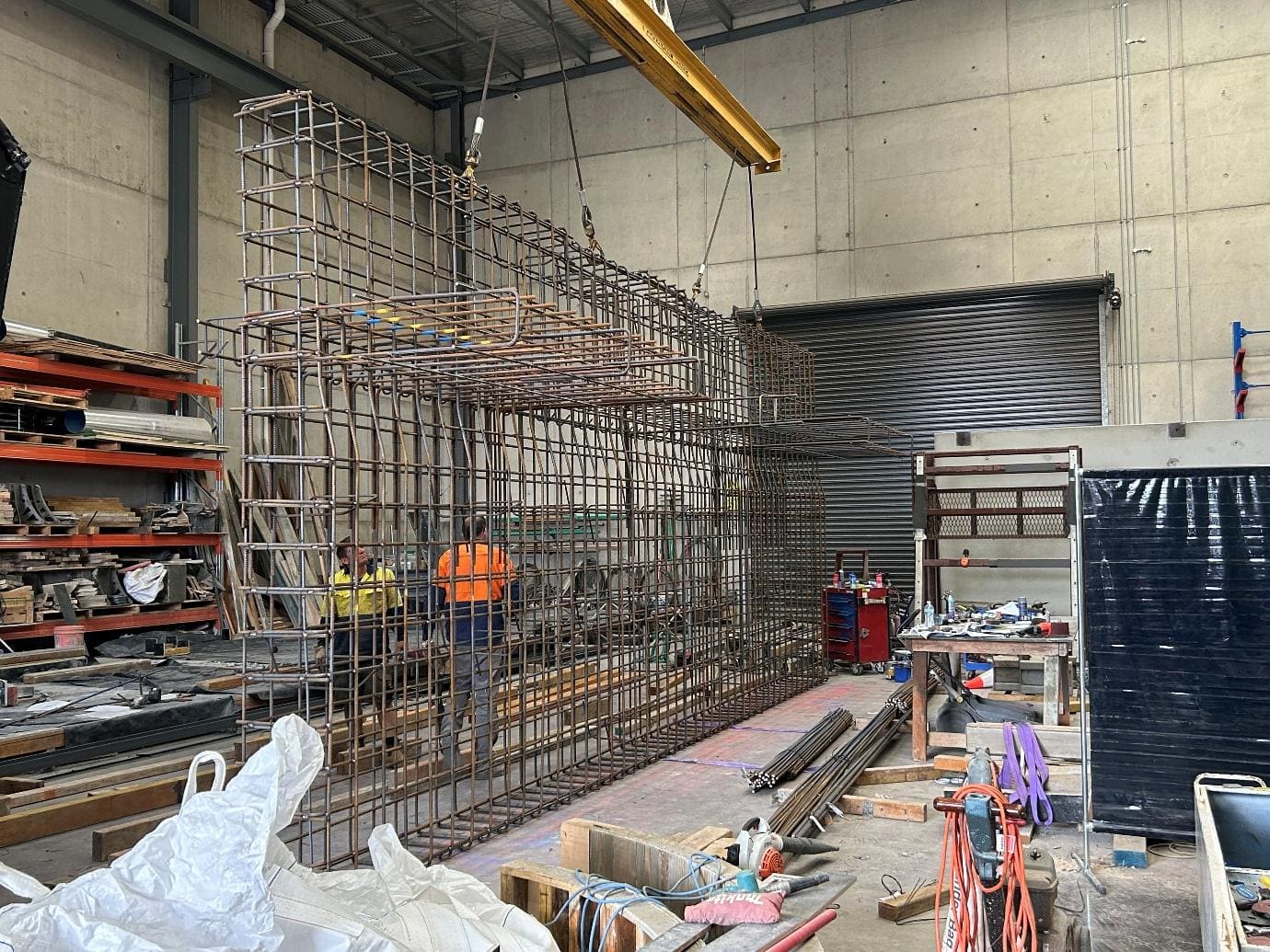
Rather than attempting to fabricate reinforcing steel cages on site under restrictive conditions, we leveraged our 3,000m² Torquay facility to prefabricate and weld all reinforcement in a controlled warehouse environment. We don’t outsource to third-party fabrication shops—this was in-house manufacturing using our own equipment, our own qualified welders, and our own quality control protocols throughout the entire process.
The operational advantages were immediate and substantial. Working in our warehouse rather than crouched beneath a bridge structure allowed for:
Precision dimensional control - Engineering drawings specify reinforcement placement within 5mm tolerances. In a controlled factory environment with proper lighting, level working surfaces, and calibrated equipment, achieving these tolerances is straightforward. On site, in cramped conditions with uneven ground and limited visibility, it becomes extremely difficult.
Superior welding quality - Structural steel welding requires specific procedures, qualified welders, and consistent conditions. Our workshop environment ensures every weld meets Australian Standards without the compromises that field welding often requires.
Complete elimination of weather-related delays - Rain, wind, and temperature extremes don't stop the schedule when you're working indoors. The fabrication phase proceeded without a single weather delay.
Parallel workflows that compress project timelines - While civil contractors prepared foundations in Mansfield, our fabrication team worked simultaneously in Torquay. This parallel approach cuts weeks from the overall project schedule compared to sequential on-site construction.
Most importantly, working in our own facility meant we retained complete control over the critical path. With no waiting for external fabricators to fit our job into their schedule, nor back-and-forth over quality issues with a third party, and finally no uncertainty about when components would be ready.
Vertical Integration in Action: No External Dependencies
Here's where our integrated model delivered its most significant advantage. Once the reinforcement cages were complete, we weren't bound by the uncertainty that defines the fragmented nature of construction delivery. With Chalmers Constructions Integrated Value, this means you’re not crossing your fingers hoping:
For crane availability from external hire companies who might bump your job for a higher-value client.
To coordinate schedules between multiple subcontractors, each with their own availability constraints and weather-delay clauses, Or
To deal with the finger-pointing that most likely occurs when transport timing doesn't match with crane availability.
We just loaded the fabricated elements onto our own semi-trailer, transported them to Mansfield on our schedule, and deployed our 120-tonne Liebherr LTM 1120-4.1 crane to site with our own operator who had been briefed directly by the fabrication team about exact rigging points and load characteristics.
This is the operational reality of vertical integration. The crane that would lift these complex assemblies into position wasn't "hopefully available next Tuesday" or "booked pending the previous job's completion."
It was our crane, dispatched on our timeline, operated by our crew who understood the exact rigging requirements because they work for the same company that fabricated the steel.
The 120T Liebherr's 66-metre telescopic boom proved essential for this specific project geometry. The restricted access beneath the bridge structure meant positioning options were severely limited—there was essentially one location where the crane could be set up without interfering with traffic or existing infrastructure. Yet from that single position, the boom needed sufficient reach to place reinforcement assemblies precisely across the entire work zone.
The combination of 120-tonne lift capacity and 66-metre reach allowed us to execute complex placements—some weighing several tonnes—from that single crane position. This eliminated the time-consuming and costly process of breaking down the crane, relocating it to a different position, and setting up again multiple times during installation. A single setup, multiple complex lifts, precise placement throughout.
For projects with access constraints, this capability difference is not marginal—it's often the difference between a project being viable or impractical.
The Complete Package: Why Single-Point Accountability Matters
With reinforcement positioned exactly as engineered, concrete placement proceeded efficiently. But the real value of vertical integration becomes visible when something doesn't go perfectly to plan—because on construction sites, something never does.
When the same company that fabricated the steel also positioned it and will pour the concrete, there's no ambiguity about accountability.
Consider the alternative scenario:
Fragmented delivery model: If reinforcement dimensions don't match the engineered drawings, who's responsible? The fabrication shop claims they built the drawings provided. The crane contractor says they placed the steel exactly where they were directed. The concrete contractor points out they can only pour around the reinforcement as installed. The general contractor spends days sorting out liability while the project sits idle.
Integrated delivery model: If dimensions need adjustment, our team identifies it, discusses it internally, implements the solution, and moves forward—often within hours rather than days. There's no contractual boundary to navigate, no external supplier to coordinate with, no debate over change order costs.
Deadset mate, this isn't hypothetical
On the Mansfield project, site conditions revealed a minor discrepancy between design assumptions and as-built bridge geometry. Because our fabrication team, transport crew, and installation operators all work under the same management structure, the adjustment was handled through a single phone call, a minor field modification, and continued progress. An external subcontractor network would have required formal written notifications, clarification of responsibility, change order negotiation, and schedule disruption.
The client dealt with one construction partner. One team understood the complete technical requirements from fabrication through to final concrete finish. One company held responsibility for the outcome. When questions arose, one phone number got answers.
This is what vertical integration delivers on complex projects: certainty. Not just quality work, but guaranteed timelines and single-point accountability that eliminates the coordination risks inherent in fragmented construction delivery.
Engineering for Extreme Conditions: Drawing on Two Decades of Specialized Experience
Projects like this bridge work in Mansfield aren't one-off challenges for our team, they're capabilities we’ve developed over 20+ years of specialised alpine construction at Mt Buller. Working in extreme mountain conditions, where access is limited, weather is unforgiving, and structural precision is non-negotiable, has honed our ability to engineer solutions for the most demanding environments.
Whether it's restricted access beneath a bridge or building in conditions with snow loads and frost penetration, the fundamental challenge remains the same: how do you deliver complex structural work when site conditions make conventional methods impractical?
Our answer has consistently been to do what we do best and leverage our integrated capabilities:
control the fabrication environment,
deploy our own heavy lifting assets, and
maintain complete project accountability.
The Strategic Capabilities That Set Us Apart
This Mansfield project exemplifies three core differentiators that define Chalmers Constructions in the Greater Geelong construction market:
Complete Vertical Integration
We don't just install concrete—we control the entire value chain. From our 3,000m² Torquay facility with dual casting beds and overhead cranes, through our transport fleet, to our 120T Liebherr installation capability, we own and operate the complete manufacturing-to-installation process. This eliminates the margin stacking, scheduling uncertainties, and coordination failures that plague projects relying on external subcontractor networks.
Strategic Equipment Assets
Our 120-tonne Liebherr LTM 1120-4.1 all-terrain mobile crane isn't just hired capacity—it's a strategic asset that provides scheduling certainty and technical capability unavailable through external crane hire. The 66m telescopic boom, VarioBase® variable support system, and precision load monitoring give us the ability to execute complex lifts in confined spaces where other contractors would struggle to operate.
Proven Capability in Demanding Environments
From alpine construction requiring extreme structural resilience to complex bridge works with restricted access, our portfolio demonstrates consistent delivery in conditions where precise engineering and integrated execution are the only paths to success. This isn't theoretical capability—it's demonstrated performance across two decades of challenging projects.
The Competitive Advantage: Why This Matters for Your Next Project
The Mansfield bridge project wasn't just about pouring concrete beneath a structure. It demonstrates how a vertically integrated construction partner solves problems that fragmented delivery models cannot.
When your project involves restricted access, complex engineering, or demanding timelines, you need a contractor who doesn't just coordinate subcontractors—you need one who controls the critical path. One who owns the manufacturing capability to prefabricate complex assemblies. One who operates the heavy lifting assets to position them precisely. One who holds complete accountability from fabrication through final installation.
That's what vertical integration delivers. That's what made the Mansfield project successful despite its inherent challenges. And that's the fundamental difference between Chalmers Constructions and contractors who simply assemble external suppliers.
For developers, architects, and engineers working on projects where access is constrained, timelines are aggressive, or structural precision is non-negotiable, the lesson from Mansfield is clear: the contractor who controls their complete value chain is the contractor who delivers certainty.
Frequently Asked Questions
About This Project
Location: Bridge works, Mansfield, Victoria
Scope: Complex reinforced concrete works in restricted access conditions
Key Challenges: Limited working space, confined site access, precision placement requirements
Chalmers Solution: In-house reo fabrication at Torquay facility, transport with company fleet, precision installation with owned 120T crane
Outcome: High-quality structural concrete delivered on schedule despite challenging site conditions